Showing posts with label youtube. Show all posts

Tuesday, November 5, 2013

Video Book Review

So here's my video book review of Marshall McLuhan's Understanding Media: The Extensions of Man (or follow this link for just the powerpoint version without voiceover). PS - don't know why the graphic is blurry for the voiceover version and not the music version, but I can try editing that later.


Steps:
  1. Think a really long time about what to do to be creative at least a little
  2. Go to YouTube and click on creation tools (that you read as curation tools and got really excited for but then realize you read that wrong)
    • Let their free audio library entertain you for about ten minutes
    • Download three of their free audio clips to use for video
      • Of course reading the terms and conditions first to avoid copyright issue
  3. Realize your camera on your computer is feeling uncooperative but no fear because creativity is here!
  4. Make fun powerpoint to explain points of book and use microphone to do voice over parts do give it that personal connection feel
  5. Edit a bit using Windows Live Movie Maker
  6. Post it and tag it with digiculture326
  7. Wish you had your puppets from last semester's videos with you and not at home so they can make a surprise cameo appearance (and then proceed to watch those videos again and appreciate the cheap quality and brevity there too)
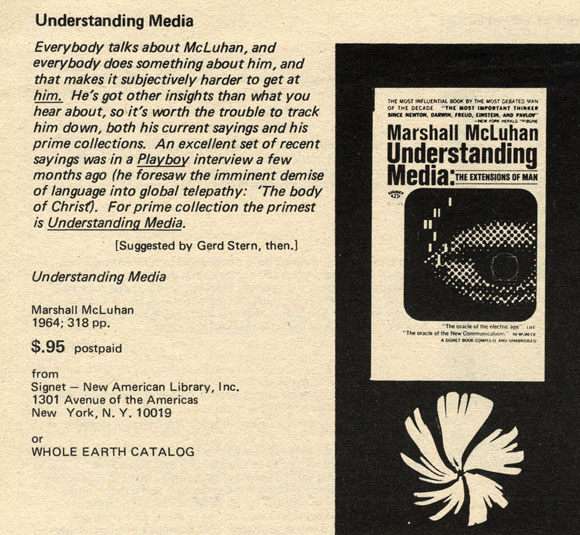
Advertisement for Understanding Media: The Extensions of Man in the Whole Earth Catalog
I didn't find any video book reviews (and I've made a post before on how many interviews there are on YouTube) but I did find this fellow blog post that mentions how the book was meant to stir questions about the technological world and not meant to ask and answer those questions. I also found this cool image (left) on http://www.moma.org (click through for full link, scroll down a little more than half way to find subheading Mediated Art) and a mini review of McLuhan's Understanding Media. I thought it looked pretty cool. Plus it's a short review (tiered content model with this little ad and review all in one, yeah?) to get the book noticed and selling.

Lots of fun with making this review and researching this book. Hopefully all my mentions of it on here and Google+ (as well as to friends of mine) will spread the word some more about McLuhan's contributions to digital thought!

Sunday, November 3, 2013

Curating Youtube (with my Topic)

My original idea for my topic was to look at "the person behind the content" and how they decide where to put their ideas from all the digital tools and outlets there are online (how does someone pick between uploading a video straight to a blog verses putting it on YouTube or Vimeo, what makes it different for one person, etc). This idea has kind of morphed now into authors on the internet. I suppose my thesis is that authors can no longer be successful (or at least it is very difficult to get successful) without putting themselves out there in the digital world to get exposure. Using YouTube, I've found out a lot about what successful authors think about the written word becoming a digital phenomenon.

First I searched "authors on youtube" and found the channel Meet Our Authors. They don't have very many views on their videos, but they are still videos on authors doing readings and explaining their works. Ironically, one of their videos is "Captain Ahab vs The Wind." Spoiler alert: it has nothing to do with writing or Moby Dick.

I then scrolled down just a bit more to find the channel Talks at Google. One of their tags is author's@google so I pulled up a different window and searched that tag as well. There are videos on authors talking directly about digital culture, like Tom Standage. There are authors just talking about their works and themselves. Either way, these authors are taking advantage of YouTube, as well as other digital sources available online. The authors@google has a blog, the project Talks at Google as a twitter account and this post talks about the Google Talks project and the authors that have featured there, as well as links to free audiobooks by those authors (another way authors are getting out there - audiobooks!).

So there's a lot to look at and research. I have lots of videos to watch by the authors themselves and I'll have to comb through to find the videos directly talking about putting their work out there in the digital world and how they feel about it, but I've gotten more info than I thought I actually would using YouTube as a curation tool.

Do you guys know of any authors that have utilized the internet to connect with their readers or get their work out there?

Wednesday, October 30, 2013

Copyright Fighting Piracy

Going off of Kayla's post, I like the theory that "if you are using something non-commercially and it doesn't affect the market for the copyrighted work, it should be fair use." Unfortunately, I think the problem lies with the piracy more than anything, and this is why this theory can't work. At least not yet. Yes, the outdated copyright laws should be updated. Why hasn't it been updated yet? I think it has to do with the fact that creators of content like using the current copyright laws to protect their work against piracy (or anything that could put their work in a bad light OR take away potential profit).

Quick Point on Piracy: 
The anti-piracy bills SOPA/PIPA in early 2012 was an attempt to fix piracy. Big name websites like Wikipedia, Google, Tumblr, Twitter, and YouTube all protested these bills (check out this article for a refresher on the internet wide blackout) because it was not only blocking piracy, it was destroying creativity, free knowledge for around the world, and promoting censorship. We are still in the process of finding a happy balance between blocking piracy but keeping creativity and fair use.

Example of Copyright Problem:
My curation tool is YouTube. We did talk a lot in class about the problems with YouTube's terms and conditions, as well as its appeal process. So I'm going to focus on a different side of copyright issues with YouTube that isn't necessarily YouTube-the-company's fault.

When we upload songs/movies/movie extras/etc not our own, we are taking away chances for the original content to be paid for. To break it down: artists who use streaming sites for their music get paid for it. The Beggars Group (record company Adele uses) said in a statement by founder and chairman Martin Mills that in 2012, "22% of the label group's digital revenues came from streaming - and that the majority of its artists earn more from track streams than track downloads." That sounds great. Here's the issue: when YouTubers use songs to create lyric videos or powerpoints to a certain song, the potential money that would go to the artist for their song is taken away by free listening that doesn't go back to the artists. Plus there are websites designed to rip the MP3 off videos to download onto the computer for free. The same goes for video content. By watching extras online, or watching full videos in parts on YouTube, the money that would be spent purchasing the content isn't spent at all because people can watch it for free as many times as they want (until YouTube copyright programs flag it, but with 100 hours of video content uploaded every minute, it's hard to keep up).

Here's an artist talking about how free music online has its benefits as well as downfalls:


I remember getting into a discussion with my roommate a couple years ago about how it wasn't fair for artists who make thousands of dollars to squabble over $1.99 song that's being put up on a YouTube video. Maybe if only a few people watched the video and only a handful downloaded the content illegally it would seem like a petty thing to argue about. But. It is still an artists content that they deserve payment for, no matter how rich. And when you have an estimated 82% of people on the internet downloading at least one file illegally, 24% watching streaming movies online, and 32% downloading films still in cinema, that's a lot of money not going to the owner (source may not be reliable, and I couldn't find any decent statistics on illegal downloading in US, but still - several thousand people download content illegally and that's still a lot of money).

Here's another thing though that I've just started reading about though: CD Baby. Apparently when someone uses a copyrighted song in their own video, the song's owner can use CD Baby to ID the song, place an ad on the video, and direct money from views to the owner. So why people aren't using this more often (or maybe it isn't really effective - haven't gotten to do much research on this yet) I don't know. And it still doesn't solve the problem with video content. But anyway. That's my two cents and what I've been able to research so far.

Other articles for further reading on YouTube/copyright topics:

Sunday, October 27, 2013

Youtube - Actual Curation and Academics

I realize in my last YouTube research post, I didn't focus too much on the academics behind it or curation and how the video site integrates that. I guess that's an example of posting our drafts and research while in progress - my post wasn't really about curation, even though that's what I said I did in my title! So here I'm going to look at the use of playlists and how that curates content.

YouTube adds a visual to the literal. There's a difference between reading a "how to" book or Wikihow and watching a "how to" video (what's more fun when learning to tie a tie, this guy with nice music in the background or pictures that look like they were drawn in the 90s?).There's something more than just reading about Marshall McLuhan and watching his interviews and see him talking about what he's writing (I say Marshall McLuhan because I've been researching him for our book project). As a visual learner, I think that's why YouTube not only has success in the pop culture aspect of the digital world, but the academic world as well.

I just want to point out quickly some different ways Youtube curates content before talking about playlists and academics: the suggested videos on the side about what you're interested in, tags on videos, annotations that include links in videos to related topics, and view count (including likes and dislikes) all curate content. MarketingProf’s Chief Content Officer Ann Handley said "content curation is the act of continually identifying, selecting and sharing the best and most relevant online content and other online resources (and by that I mean articles, blog posts, videos, photos [etc]) on a specific subject to match the needs of a specific audience." So for YouTube, we find reliable sources based on us watching certain videos, the cookies of our searches on the computer that websites analyze to help suggest content to view, the tags we search and the YouTubers we deem reliable after giving them our attention.

So what are the good ways in which YouTube has promoted academic content, or at least authoritative content? It preserves content, for one thing. When I was searching Marshall McLuhan, one of the first things that popped up were playlists made by random people (without lots of subscribers or views) collecting his interviews and putting them all into one list. So how did I pick one playlist over another? And what gives these YouTubers with hardly any views or followers rights over another? Well for one thing - these playlist creators spent enough free time to make a playlist on their own about Marshall McLuhan. If they didn't care, do you think they'd waste time putting a playlist together? I wouldn't. Also: by looking at the titles and video icons, I can tell which interviews are actually about the subject I'm researching and which aren't. Plus all these videos are interviews and content right from television or radio stations and put right into a video. Can't get more reliable than a video of the actual author himself. So what improvements can be made to create reliability behind curation and content?

I'm not really sure I have an answer to that yet. I had a brief thought that if profiles on YouTube were more important to look at than the actual videos, the people behind the uploads would be more reliable. But you know...I don't think that's true. Part of this class is about finding what's on the internet and deciding what's good content vs the anthologies the rest of our classes require us to read because that's "reliable and scholarly." I don't know anything about the three or five or ten anthology writers with expertise and doctorates to make them more reliable than the video upload or blog post. And to be honest, I'd much prefer to spend my time reading something that motivates people enough to create a video response to a book or write a blog post or create a playlist of everything their favorite author has made an appearance in. There is something raw and real about people with pure intent and interest in something. It's more personal to research the every day person writing/vlogging/etc about something that interests them than reading a 5000 paged book with big words and a hundred patents and twelve editions. And in the end, one person making a video or post about something they care about makes them more than ordinary. It makes them an active participant in something greater. It involves them in a community of learning that unfortunately many universities and schools are too scared to find useful yet.

But times are changing just as the digital world is. Maybe we'll stop being book snobs and be all-media-accepting some day.
Monday, October 21, 2013

YouTube Curation

So I'm looking further into YouTube curation. What I've realized more and more in my research is that this isn't just about putting up videos and getting a lot of hits. It's about advertising yourself, your product, your talents, your history, your world. People use YouTube academically, for entertainment, for literal advertisements, for business, for anything and everything. There's so much more to it than just making videos.

First, here's a link to why the advertisements on YouTube (that most viewers find annoying) actually turn out to be successful for those advertising companies. It's a playlist called YouTube Case Studies.

There's even a page on YouTube telling potential advertisers Why It Works. YouTube only charges when people watch your ad. It provides a targeted audience for companies looking to advertise. It's not just ads on television where someone can change the screen, but it provides videos across the internet which means people with access to computers, phones, tablets, etc can see the ad. There are analytic tools that give stats on who's viewing a company's ad and these companies can build a following by making their own channel.

Of course YouTube also has their Partnership Program to help their creators. And of course here's the list of the top 100 most subscribed channels where every day people are making it on the internet (just ignore the music channels like Rihanna and One Direction). To check out success stories just type in Draw My Life and there will be plenty of youtubers who talk about how they ended up making videos and how this channel changed their life. This video is long, but it incorporates a lot of how collaboration, crowdsourcing, and just using the things available to you will get you to where you want to be:

(sWooZie's Draw My Life video)

Of course there is the academic side of YouTube that I'd like to explore too. Having plays up to watch in parts (which I do for my Shakespeare class), watching PBS or Discovery, or even uploading AP Literature projects or class projects is a fun way to get information out there. In class we discussed how sometimes we search online how to do things for a visual on what to do. So I suppose one of the questions I'll have to look into more is what makes the source qualified or authoritative?

I'm still working on getting more information and everything, but. I'm really excited to explore this more.