Showing posts with label digital culture. Show all posts

Wednesday, December 18, 2013

Anchored in Humanity: Digital Insights in Literature

Studying literature in the traditional way is a key to powerful insights into digital culture. It's because literature and digital culture stem from the same thing: people. The literary tradition has a long history of delving into the human condition through its forms, and it helps people better understand the effects and biases of digital culture in and among humanity. Here are a couple of examples of insights I have seen this semester.

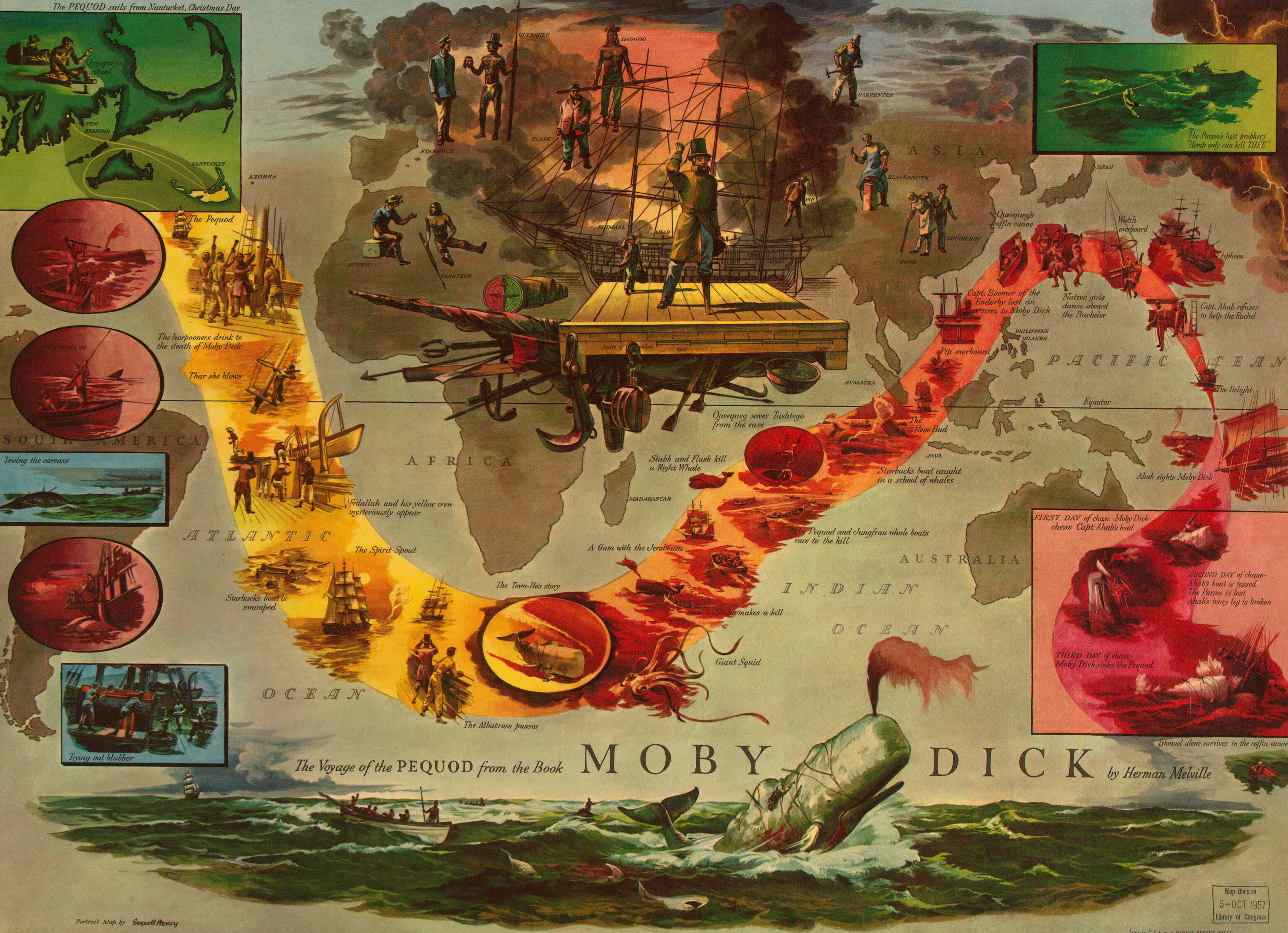
Our classmate Aleesha saw correlations between Pinterest and her literary study of Moby Dick. Her questions about the identity (e.g. genre) of the novel Moby Dick prompted questioning and a project about how the individual and collective pins of a person's Pinterest board reflect (or don't reflect) the identity of the pinner. Kayla pointed out how Captain Ahab deliberately gathered people around him and sought the advice of his peers in going after the whale. With their help, he succeeded. Sure, you could say that that was the way everyone had to do things, back in the day, but - it was effective. 

What literary study helps us discover can and should change digital habits. The amount of information online and in print is overwhelming, like the amount of organisms in a world of ocean. As well as consulting his fellow captains for up-to-date information on Moby Dick, Ahab had on hand with him more traditional aids in his search: "yellowish sea-charts" and "piles of old log-books" (177). These print resources were also invaluable to him in making his "reasonable surmises" (177) about the route of the white whale. Recognizing the limitations of each method, Ahab used both textual information and social research and proof to accomplish his goal. While many Web users might be tempted to favor either a search engine or asking people for help to find what they are looking for, we would do well to follow Ahab's example and use social and mechanical ways to find what we want. 

Aleesha, Kayla, and I are digital natives, but studying Moby Dick gave us valuable insights into our world.

Essay #2: The Advantage of Online Publishing

I propose the department take advantage of and teach the pros (and cons) of online publishing. With digital culture there is an awareness and availability to criticize and create content in new forms unavailable in traditional formats of publishing literature. Traditional publishing happens through submitting a scholarly article to a print journal which takes months, maybe even years to get to publication. There is reviewing, maybe getting accepted, then waiting for publication, and all of this to only have a few libraries hold the journal you have submitted to. Online publishing takes the waiting out of the process and allows for anyone to publish anything, and there are ways to keep it scholarly and academic.

Outlets online have continued traditional scholarly outlets of academic journals, but they are faster because submission is all electronic. It cuts costs. There is a wider availability. Using curation tools such as Twitter, Facebook, and Google+, an author can announce their intent to research and publish on a topic. Then they use crowdsourcing and social proofing to gather information from friends, peers, enthusiasts, and scholars to contribute to their research. Then as the author publishes their work and continue to curate their researched content, they get more feedback or information on their topic by comments or reviews or submissions from others interested in the field. Even if someone was publishing something nonacademic, personal blogs or websites can claim authority in a field by amount of views, responses, gatekeepers, and/or following.

Digital culture makes publishing an accessible to anyone, which leaves a lot of room for amateur or unedited publications. In these cases people must be aware of the sources they get their information from as well as where they intend to publish. Websites with .gov or .edu are usually more reliable than .com sites. The more times an item or article has been reviewed, the more chances you have of reading accurate reviews of a piece. Goodreads and Amazon for example has rating systems for book reviews that can help narrow down the academic reviews from the more emotional-based ones. In the end, there are ways to find scholarly and authoritative sources of information from the freelance works.

With online publishing, students can be successful quickly. Fellow students Paul and Greg have proven that social proofing gets their works recognized and/or published (see here and here for their successes in social proof and digital publication, respectively). In a world with digital opportunities to get ideas curated and published, the humanities department should be taking advantage of these opportunities to promote their own work as well as teach students how to enter the digital world with their own writing.

Essay #1: Collaboration and Community of Moby Dick and Digital Culture

When we read literature, it is an individual action. It is between the reader and the text. Sure there are ways to discuss a piece of literature such as publishing an anthology or writing a research paper, but these avenues take time. Digital culture makes it bigger. With literature, we are able to see the world through one book’s perspective and as a critically thinking community, interpret the book’s ideas and either agree or disagree with them. In digital culture we do the same, but now on a massive scale where people from all different backgrounds come together to collaboration and give feedback on literature. It turns an independent reading to a global one.

In the introduction of Moby Dick it reveals that “Melville himself certainly believed that all men are united by the bond of reciprocal dependence, by a community of function and responsibility” (xv). The book itself is an example of this “community of function.” We have discussed in class how the book functions under different genres: epic, fiction, prose, allegory, play. The compilation of all these genres makes it impossible to identify it as one genre. In digital culture, people are represented by the different social media sites they use. As Aleesha demonstrates in her research, Pinterest is a way for pinners to repin a variety of pictures, outfits, recipes, etc. Identifying a person by one pin will not be a full representation of who that person is or their pin board. It would be like identifying Ishmael as only a sailor and ignoring his obvious knowledge of cetology, his background in teaching, and the fact that he is the narrator.


As a community, men “united by the bond of reciprocal dependence” create subcultures in which members mutually depend on one another to not only consume content, but to create and curate it as well. In Lizy’s research on fandom collaboration, crowdsourcing materials such as memes or articles on a particular show or book creates a wider fan base in which content can be remixed and shared to an even larger crowd. Information is shared and spread through curation tools such as Tumblr or Facebook or Twitter. Captain Ahab gathered his crew together, all of them dependent upon finding Moby Dick to complete their whaling mission, and together they sailed in search for the great white whale. Ahab used "every means at his disposal to find and kill the white whale" (30), including sea charts, books, and logs to determine where to find Moby Dick. He was crowdsourcing information when he spoke to fellow captains on the Rachel for example to get spotting information. It was a community effort for one common goal. The subcultures within digital culture come together as a community to read, review, comment, and remix content found in literature. Reading is no longer independent, or at least it doesn't have to be.

Digital Curation: Optimizing Literary Study

I propose that the department increase its usage of online curation tools.

Curation is a staple of the digital experience is a big part of popular online services like Pinterest and Flickr, YouTube’s Playlists, and Diigo. With Google+, one can even curate and organize their friends. For academic purposes, curation can be up-to-the-minute crowdsourced research on a student’s topic of choice. 

Traditional sources for curated content include academic journals and printed books. These resources are invaluable to much literary study and analysis by providing context for the work and to bring people into the conversations surrounding the work. However, an individual must often go to a library, a store, or (more recently) subscribe to an costly online database like JSTOR to access these treasures. If they use a library, they cannot make notes in the book to help themselves process its contents and pick out what parts are useful. Additionally, since these traditional sources and the usual ways of finding them involve few if any human sources to recommend the best titles, what the student does access may be an off-target, barely relevant, or simply incomplete resource for the topic at hand.

The department and its students would greatly benefit by have students research and curate together using online tools. If two students are studying similar topics, digital curation will help them easily access each other’s research as well as the research and resource recommendations of tens of other amateurs, students, and scholars. With a more efficient and current research system, students will use the curation tools of the digital age to become more knowledgeable scholars and analysts in their fields of interest, leading to lifelong learning and teaching.

Digital Culture's Subculture: Reflections by Amber


Coming into this class I thought I had a pretty decent understanding of what the internet was. Turns out, it’s more than just a source where people watch youtube videos, look at pictures, blog, and research. It’s an entire culture (digital culture) that’s made up of subcultures where people with specific interests can connect, consume, and create content.

In Lizy’s research and projects on fandoms, I’ve seen how people really dedicated to a show like Agents of S.H.I.E.L.D. or Doctor Who will collaborate with various forms of media (Tumblr, Pinterest, even Google Doodles) to share their passion in memes and other remixed content. I think more specifically I’ve seen the subcultures of digital culture with Greg, Heidi, and Paul’s extensive research and analysis of video games. They have a lot more information on how people inside and outside the video game community are grappling with issues such as gender politics and identity both online and offline. Ultimately, entire communities exist in the digital world. Whether it’s with Pinterest, online games, fandoms, Youtube, these are not just people using the internet to share their content. It’s people using the internet as a member of online mini-civilizations.

When I read Understanding Media: The Extensions of Man, I found that I rather agree with Marshall McLuhan on the idea that the medium is a part of us; it is an extension of who we are as creators and consumers of content. No matter what position on the long tail of interests we pursue, there’s always going to be someone else out there who is using the internet to research and invest their time and energies into something we like too. I honestly really doubted the idea of socialproofing. I didn’t think anyone would be interested in my ideas of authors entering the digital age. Or at least I didn’t think I would hear anything from people who were apart of this subculture. But after investing my time in getting social proof (with Google+ updates, sending tweets or emails, commenting on other blogs, etc) I realized that it actually can work. You just have to ask the right people. Talking with our homies or peers is easy, and finding scholars or activists in the communities you’re interested in becomes easier when you start really reaching for student research and crowdsource information to get your ideas out there. Digital culture, in its subcultures individually and combined, are an extension of ourselves and our ideas with the collaboration of others in the same interests.

In all of this new understanding of subcultures in digital culture, and how we use these subcultures to explore our interests and creativity, there is still a lot that I have to learn and more importantly utilize. I now have a blog account, a google+ account, a twitter account, an lds.org account, and I've never been that active online before because I've never had the desire to be out there that much on the internet. Now I know that it isn't such a bad thing to be active online. It's like being in a second world where I can be out at sea and explore on my own ship, then I can talk with other crew members in my subculture, other ships in other subcultures, and ultimately have my own life online too.

Wikipedia Creative Commons Image
(a clearly very accurate depiction of subcultures on the internet in my journey through digital culture)

Tuesday, December 10, 2013

Working Outline

Sorry this is super late. I forgot about making this post in the midst of working on my project and final paper (not to mention all the other stuff going on for other classes - crazy end of semester blues!). Here is the rough draft outline I used to help write my paper. Not exactly the order I went in and my paper includes a lot more detail than this (obviously and hopefully). Also check out my project prototype blog of reformatting Moby Dick which in part helped me in writing this paper. I had fun with it. Please leave comments there (for now comments will be approved by me in an email it sends to me before being published, but I can change that later).

Monday, November 18, 2013

Moby Dick: A Book Before It's Time

At the time of publication, Melville only sold 500 copies of Moby Dick in the UK compared to 6,700 copies of his first book Typee; although it sold fairer in the US with 3,215 copies, it still sold less than four previous books by him (source). Considering how famous the book is now, what is something Ishmael is doing that gets his every day journal entries, random rantings, and mini lectures so many views? Perhaps it isn't the book itself finally getting credit where it's due, but in this day of age the readers have adapted to the book's style. To put in layman's terms: Ishmael is actually a first edition blogger.

Wednesday, November 13, 2013

Final Project Thoughts (Extra Post, Prologue to Post 2 of this week)

Beware! I am posting my prewriting and rough drafts, showing my progressive steps, diving into the second stage of academic blogging, and saying social proof doesn't always work.

This isn't my second post for the week about digital tools with Moby Dick, but I will link to it at the bottom after it's published. This is a prologue for what I'll do in that post and how I got to that idea.

This is a post about my final topic. If you guys can comment, it will help me with my theme and tell me if this is something I can actually do a final project on. Even if you only read the last couple paragraphs under the asterisks, that will really help me. Or comment here on Google+ for an even faster read and respond. Give me social proof, homies and peers!

Tuesday, November 5, 2013

Video Book Review

So here's my video book review of Marshall McLuhan's Understanding Media: The Extensions of Man (or follow this link for just the powerpoint version without voiceover). PS - don't know why the graphic is blurry for the voiceover version and not the music version, but I can try editing that later.


Steps:
  1. Think a really long time about what to do to be creative at least a little
  2. Go to YouTube and click on creation tools (that you read as curation tools and got really excited for but then realize you read that wrong)
    • Let their free audio library entertain you for about ten minutes
    • Download three of their free audio clips to use for video
      • Of course reading the terms and conditions first to avoid copyright issue
  3. Realize your camera on your computer is feeling uncooperative but no fear because creativity is here!
  4. Make fun powerpoint to explain points of book and use microphone to do voice over parts do give it that personal connection feel
  5. Edit a bit using Windows Live Movie Maker
  6. Post it and tag it with digiculture326
  7. Wish you had your puppets from last semester's videos with you and not at home so they can make a surprise cameo appearance (and then proceed to watch those videos again and appreciate the cheap quality and brevity there too)
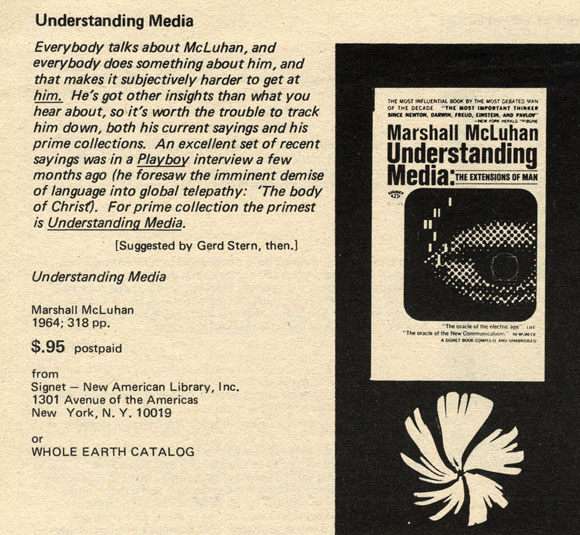
Advertisement for Understanding Media: The Extensions of Man in the Whole Earth Catalog
I didn't find any video book reviews (and I've made a post before on how many interviews there are on YouTube) but I did find this fellow blog post that mentions how the book was meant to stir questions about the technological world and not meant to ask and answer those questions. I also found this cool image (left) on http://www.moma.org (click through for full link, scroll down a little more than half way to find subheading Mediated Art) and a mini review of McLuhan's Understanding Media. I thought it looked pretty cool. Plus it's a short review (tiered content model with this little ad and review all in one, yeah?) to get the book noticed and selling.

Lots of fun with making this review and researching this book. Hopefully all my mentions of it on here and Google+ (as well as to friends of mine) will spread the word some more about McLuhan's contributions to digital thought!

Wednesday, October 30, 2013

Copyright Fighting Piracy

Going off of Kayla's post, I like the theory that "if you are using something non-commercially and it doesn't affect the market for the copyrighted work, it should be fair use." Unfortunately, I think the problem lies with the piracy more than anything, and this is why this theory can't work. At least not yet. Yes, the outdated copyright laws should be updated. Why hasn't it been updated yet? I think it has to do with the fact that creators of content like using the current copyright laws to protect their work against piracy (or anything that could put their work in a bad light OR take away potential profit).

Quick Point on Piracy: 
The anti-piracy bills SOPA/PIPA in early 2012 was an attempt to fix piracy. Big name websites like Wikipedia, Google, Tumblr, Twitter, and YouTube all protested these bills (check out this article for a refresher on the internet wide blackout) because it was not only blocking piracy, it was destroying creativity, free knowledge for around the world, and promoting censorship. We are still in the process of finding a happy balance between blocking piracy but keeping creativity and fair use.

Example of Copyright Problem:
My curation tool is YouTube. We did talk a lot in class about the problems with YouTube's terms and conditions, as well as its appeal process. So I'm going to focus on a different side of copyright issues with YouTube that isn't necessarily YouTube-the-company's fault.

When we upload songs/movies/movie extras/etc not our own, we are taking away chances for the original content to be paid for. To break it down: artists who use streaming sites for their music get paid for it. The Beggars Group (record company Adele uses) said in a statement by founder and chairman Martin Mills that in 2012, "22% of the label group's digital revenues came from streaming - and that the majority of its artists earn more from track streams than track downloads." That sounds great. Here's the issue: when YouTubers use songs to create lyric videos or powerpoints to a certain song, the potential money that would go to the artist for their song is taken away by free listening that doesn't go back to the artists. Plus there are websites designed to rip the MP3 off videos to download onto the computer for free. The same goes for video content. By watching extras online, or watching full videos in parts on YouTube, the money that would be spent purchasing the content isn't spent at all because people can watch it for free as many times as they want (until YouTube copyright programs flag it, but with 100 hours of video content uploaded every minute, it's hard to keep up).

Here's an artist talking about how free music online has its benefits as well as downfalls:


I remember getting into a discussion with my roommate a couple years ago about how it wasn't fair for artists who make thousands of dollars to squabble over $1.99 song that's being put up on a YouTube video. Maybe if only a few people watched the video and only a handful downloaded the content illegally it would seem like a petty thing to argue about. But. It is still an artists content that they deserve payment for, no matter how rich. And when you have an estimated 82% of people on the internet downloading at least one file illegally, 24% watching streaming movies online, and 32% downloading films still in cinema, that's a lot of money not going to the owner (source may not be reliable, and I couldn't find any decent statistics on illegal downloading in US, but still - several thousand people download content illegally and that's still a lot of money).

Here's another thing though that I've just started reading about though: CD Baby. Apparently when someone uses a copyrighted song in their own video, the song's owner can use CD Baby to ID the song, place an ad on the video, and direct money from views to the owner. So why people aren't using this more often (or maybe it isn't really effective - haven't gotten to do much research on this yet) I don't know. And it still doesn't solve the problem with video content. But anyway. That's my two cents and what I've been able to research so far.

Other articles for further reading on YouTube/copyright topics:

Monday, October 28, 2013

Directing Your Digital Fate: Douglas Rushkoff's Program or be Programmed: Ten Commands for a Digital Age

I've heard conflicting opinions about the healthiness vs. usefulness of internet immersion, and have consequently felt guilty about all the time I spend online and been hesitant to immerse myself even more. Rushkoff’s book  Program or Be Programmed: Ten Commands for a Digital Age has a good reader rating on Amazon and is about the best ways to digitally immerse ourselves, so I'm checking it out.

After skimming this book, I see that the author focuses a lot on telling the reader the way humans work and the way the internet works in order to tell the humans how to make the internet work their way. This is reflected in the illustrations, whose main subjects are always human. Several of the chapters have italicized paragraphs at the beginning, which seem like a sort of abstract of the chapter.


Early Social Proof


When I posted on some social sites that I was reading this book, I asked, “What’s the best way to go about life & digital life in the Digital Age?” I received some responses on Facebook: my aunt and cousin “liked” the status, and my mom gave a couple of pieces of advice to answer that question. They were concerned with protecting one’s digital identity and reputation, with passwords and posting intelligently. While it wasn't quite the angle I’m looking at, her response does reflect the “be careful” attitude my family has about internet activity.

Similar Books

When I looked for similar books on Amazon and Google Books, both search engines recommended more of Rushkoff’s books. Amazon recommended three – Coercion: Why We Listen to What “They” Say; Life, Inc.: How Corporatism Conquered the World, and How WE Can Take It Back; and Present Shock: When Everything Happens Now.” Google Books just included the latter. Present Shock also happens to be more current that the book I’m reading; it was published in this year, whereas the other was published in 2011. It seems to delve further into the “command” of one of the chapters in Program or be Programmed: “Do Not Be Always On.” Other books the engines recommended are also about the psychology of the internet, how business can use the internet and how corporations have taken over the internet; and even Unbored: The Essential Field Guide to Serious Fun.

 Who Cares?

When searching for this book and its author on Twitter, I found several mentions of Rushkoff and his book from people in several countries and of several backgrounds. Usually, though, their backgrounds had something to do with computers or brand marketing. There were also YouTube links to the author’s presentations about the book’s message, and links to a couple of interview articles. When searching on Facebook, I found a fan page for the book which is not very active and has 268 likes (now 269, with my like). However, there were several interesting articles posted, which told me that Rushkoff publicly took himself off of Facebook, and also that computer ignorance is a threat to personal freedoms, since technical ignorance is being exploited in courtrooms. I shared that article on my Facebook page and on Google+. There was also a Facebook page with this book’s name, which mostly had programmer jokes.

On Google+, I mostly found links to Rushkoff’s work but I also found further explorations of the concept in education and even medicine. Recommendations of his work were generally more thoughtful than those on Twitter, since there is more space to speak on Google +. For example, John Wohn wrote four paragraphs about the book, beginning with, “Don't be put off by the title; Rushkoff is not (exactly) saying that everyone needs to be a Java programmer.” I even found a meme.

Aside from giving me more links to purchase the book and visit the author’s web site, Diigo gave me more interviews with Rushkoff and more blog posts about it, including one from a venture capitalist that mentioned that companies are desperate for programmers. Through Diigo results, I also learned that Rushkoff has helped start CodeAcademy, a free web-based site which teaches how to understand and write code.

Formal Reviews

I didn't find a formal review of Rushkoff’s book on our HBLL’s aggregate database, although I did find that he has written articles more than once for CNN. What I have seen so far tells me that he is very respected in his work and has several platforms to speak from. The closest thing to a formal review that I found was an enthusiastic blog-style review and interview article on Wired.com. 

Informal Reviews

The informal reviews I found critiqued the book and mainly found it to their liking. ChristianHumanist.org said that the book mainly asks “ten penetrating questions” rather than giving commands, which I think, based on what I’ve learned so far, is a great way to put it. I was glad to see in another article that there’s more to each “command” than its chapter title and a short summary, several versions of which I have already read in other articles. I also learned that this book won the “Neil Postman Award” (Neil Postman and Douglass Rushkoff are both Jewish and write about technology).

Course Inclusion

I found the syllabi from several classes which use Rushkoff’s book as a textbook. Some were a little surprising; though there were several computing classes requiring the book, it is also required in a writing class, a gaming class, and a major part of the Fall 2013 Introduction to Music Technology class at the University of Florida. One of the computing classes looks similar to a Digital Humanities web publishing class I’m currently taking, and I think including the book in that context would help incorporate more humanities skills in the course. 

Multimedia

There are several YouTube videos of Rushkoff speaking about the concepts of this book and of his other books. They range from a minute to over an hour. On Flickr, someone posted notes that they drew, perhaps at one of Rushkoff’s speeches. A phrase which intrigued me was “Companies should get their friends to friend each other.” Does this mean that companies should get their "friends"/competitors to network with each other?

First Impressions of the Book

On my first read of the book, I noticed Rushkoff's narrative of internet/media/human history. There’s one for nearly every “command.” Sure, the narrative is occasionally meladramatic and oversimplified – for example, “Until interactivity, we were defenseless emotional targets for the advertiser,” (Kindle Locations 293-294) – but it gets his point across and helps put the “command” into perspective.  His simplicity is one of the things which makes this book so accessible.

The point which was most novel to me was his explanation of how digital media has altered our thinking without most of us realizing it, valuing “the recent over the relevant” (Kindle Locations 361-362) and “offloading our thinking” (Kindle Location 382) and mental processes onto our computers and the Web. And by the way, the note above which mentioned companies' friends? It was saying that businesses should help their fans network with each other, to reinforce each others' patronizing of their business.

My Thinking So Far

I can understand why people recommend the book, and I look forward to reading it more in depth. I would like to examine more deeply the digital biases he points out, like the "choice filter" and attempting to be "always on" like the computer is. I'm not sure I agree with him on a section about how the digital world narrows our decisions in general, so I would like to look into that more. I might try to get my mom to listen to the audiobook so that we can discuss some of the concepts our family culture is more against, like sacrificing complete privacy for an online reputation.

Sunday, October 27, 2013

Please Excuse My Extra Post


I promise this will be quick guys, but I just wanted to share something I've basically just learned...or at least a concept that has finally broken through the walls around my brain and said HEY LOOK HERE.

I've made two Google+ posts about Matt Haig today already so sorry for the spam. But I just discovered this author through means of the internet and a good friend of mine. As majors in the humanities, I think a lot of what Matt has to say on his blog really just puts everything into perspective. At least for me.

Right now I'm going through all of his posts. Some I agree with completely, some have strong language. This one though is what I'd like to take a moment to focus on and quote profusely.

Haig says "a writer these days is not a solo player (if we ever were)" and that's funny, because I think plenty of writers like to think of themselves as a recluse who can't publish anything until it's ready and perfect for the audience to read. He goes on to say that in a digital world, he gets to be closer to his readers more than ever before. He asks for advice from his readers, talks and interacts with them because "a reader’s involvement in a book no longer starts and ends with them buying it and reading it." They put up YouTube videos (which he links in his blog post), make tweets and review it, and so on. Maybe this too is about curating content: preserving what we read by making digital responses to it and not just a personal, silent-judgment of "why yes I like this book" or "no never read the heathen cretin!"

In class we've kind of talked about how our identities on the internet is a controversial topic, from wanting to be all revealing about our personal lives to leaving the smallest digital footprint possible. I know personally I don't like having myself all out there. That's just my personality type. But with our professors' enthusiasm, and what Haig says about being positive with "the author's mystique [fading] thanks to the internet," I think I'm learning to not be so quiet anymore. We are creating communities online, curating and discussing and involving each other in ways no one has ever been able to before. Why not take advantage of that?

One more thought, I'd just like to point out Haig's concluding thoughts. He says "the internet is taking stories back to where they first started. Back to humans, telling tales to each other, and getting each other involved as we sit around the fire, or in our caves, [or our Pequods heheh] tapping into the most universal experience we have – imagination."

Hopefully this keeps you guys excited about what we're actually doing in this class, especially with midterms and everything going on in the busy middle-of-the-semester rush. If not, I'm just glad I had somewhere to post this because to me, this takes our class goals and makes it more personal for me. And hopefully Dr Burton and Dr Wickman don't mind this post here. Kudos to them for teaching me about using the digital world to my advantage!

Wednesday, October 23, 2013

Exploring George Orwell's 1984


I’m reading George Orwell’s 1984. I want to look specifically at “newspeak” and other ways Big Brother tries to control language to control people. I’d like to look at the spread of information in digital culture today and compare that with Big Brother’s suppression of information and texts.

Preview
I noticed the chapters do not have titles, and the book is divided into different sections. The lack of chapter names probably goes along with the bleak theme of the storyline and possibly the suppression of information and texts by Big Brother. There is the appendix at the end with The Principles of Newspeak. I started skimming the appendix, and there Orwell outlines the rules of Newspeak: the vocabulary, morphology, grammar, etc. Apparently Newspeak was created to diminish the overall English vocabulary and limit thought. I’m interested to see how Newspeak is actually used in the novel.

Early Social Proof
I put up a Facebook status on Tuesday morning telling my friends I was reading 1984, and I asked if they had read it or had any thoughts about it. I mentioned that I saw connections between Big Brother’s use of language and today’s politically correct language. I got a few thoughtful responses. My high school AP English teacher said, “The recent Snowden leaks about the NSA make me realize Big Brother is watching us at all times. We also are seeing the simplification of language. Have acronyms everywhere... Even shorter than contractions like "minipax." Torture was big a few years ago. Orwell was just 30 years ahead of his time.” A girl from my homeward said, “I think that the ‘perpetual war’ of 1984 is akin to the perpetual conflict between major political parties. It is a self-sustaining industry that keeps people busy and gives the impression of progress without really changing much.”

Similar Books
I searched Amazon and Google. Both sites recommended other books by George Orwell, but Amazon recommended some others that had similar themes to 1984. Amazon recommended Brave New World by Aldus Huxley, Lord of the Flies by William Golding, and Fahrenheit 451: A Novel by Ray Bradbury. Both Brave New World and Fahrenheit 451 are set in dystopian futures. The Lord of the Flies deals with the reality of the brutal aspects of human nature. All three books are cautionary tales about the possibilities of the future.

Who Cares?
I searched for “George Orwell 1984” on Facebook and Google+. Facebook informed me that 1,118,543 people “like this topic.” On Google+ I found a lot of posts from newspapers and individuals talking about the NSA surveillance scandal, PRISM, and how sales of 1984 have skyrocketed since news of the government spying broke out in the media. Apparently 1984 is still very relevant to today since people are actively talking about it, and more people are reading it with all of the concerns about big government.

Formal Reviews
I searched for reviews on the library webpage. There were several, but one I thought that was really relevant to digital culture was countering another reviewer’s claims that Orwell was not a genius. In his “Homage to George Orwell” published in the Midwest Quarterly, Peter Firchow writes, “All of his work, let me repeat, even including some minor, transitory pieces like reviews, is still in print, and his fiction and major essays a, along with much of his journalism, have been translated into just about all of the major Western languages.” He cites the availability and circulation of Orwell’s texts as a sign of Orwell’s genius as a writer. This reminded me of today where the mass circulation of someone’s words and writings can be so common that it would not necessarily distinguish them as a genius. But then again all of Orwell’s writings were published into print, and many of them are available online. One of the things that Firchow thinks is characteristic of Orwell’s literature is the tendency to create an environment that exists in the real world but to not have many specific cultural or other references to that place. In this way, Orwell creates a timelessness and a situation that everyone can place themselves in. He does this is 1984 too, where you know the main character is in England, but the character could really be in any dystopian city or country. It makes the story very applicable and powerful that way.

Informal Reviews
One review I particularly enjoyed on Goodreads gave a synopsis of the book through a completely modern lens. The reviewer says, “In George Orwell's 1984, Winston Smith is an open source developer who writes his code offline because his ISP has installed packet sniffers that are regulated by the government under the Patriot Act. It's really for his own protection, though. From, like, terrorists and DVD pirates and stuff. Like every good American, he drinks Coca-Cola and his processed food has desensitized his palate to all but four flavors: (sweet, salty-so-that-you-will-drink-more-coca-cola, sweet, and Cooler Ranch!(tm)). His benevolent overlords have provided him with some war happening somewhere for some reason so that he, and the rest of the population, can be sure that the government is really in his best interests.” This really brought the story home for me. It is obvious that 1984 can be compared to our day, but I think review is a creative way to analyze the story in today’s context and to provide social commentary.

Multimedia
A lot of media has been created about 1984. I searched tried searching for George Orwell 1984+digital culture, but I didn’t get the greatest results, so I simplified my search to 1984. I found a lot of remix images of 1984 themes and today’s politics like this picture.


 To be continued . . .

Exploring Citizen Journalism with Dan Gillmor’s We the Media

I shared this post on my Google+ account:

I've been trying to figure out what's happening with modern journalism--it seems like an article shared on Facebook gets more credit than it should without examining the source. I'm starting Dan Gillmor's book (We the Media) to start sorting through #citizenjournalism .  #amreading 
I got this book recommendation after expressing an interest in citizen journalism. I want to look at what kind of journalism and news is most valuable to people, or perhaps where they get their news. What makes a source credible?

Preview

From taking a brief preview of the book, I can see that Gillmor covers a wide range of subjects. Just from browsing I’ve seen blogs, talk radio, SMS, file sharing, podcasts, photography, and wikis as sources of information, as well as several others. Gillmor introduces his topic by talking about how the public both fact checks and adds to the professional media—people become both producers and consumers of news. Gillmor seems to take an overall positive view of grassroots journalism, though he has cautionary sections.

Marshall McLuhan's Understanding Media: The Extensions of Man and Digital Culture Participants


I am reading McLuhan's Understanding Media: The Extensions of Man to hopefully understand more about different types of media. I'm told that this book has been discussed a lot through the years (despite being dated - it was published in 1964), and it proposes that media itself, not its content, should be the focus of study. Since we've been talking about curation and I've been looking into the idea of "the man behind the post," I'm hoping I'll get some more ideas and viewpoints from reading this.

Preview
No pictures in 396 pages of content (but at least I can turn to page 394...). Other than that quick observation, I think McLuhan's going to really focus on his idea that media is what changes society and not the content it produces/supplies. It's broken into Part I and Part II, with Part I introducing his ideas, but Part II focusing on different types of media and the power of the "written word." There's a lot of metaphors - something about a light bulb and "hot media" vs "cold media."

Monday, October 21, 2013

YouTube Curation

So I'm looking further into YouTube curation. What I've realized more and more in my research is that this isn't just about putting up videos and getting a lot of hits. It's about advertising yourself, your product, your talents, your history, your world. People use YouTube academically, for entertainment, for literal advertisements, for business, for anything and everything. There's so much more to it than just making videos.

First, here's a link to why the advertisements on YouTube (that most viewers find annoying) actually turn out to be successful for those advertising companies. It's a playlist called YouTube Case Studies.

There's even a page on YouTube telling potential advertisers Why It Works. YouTube only charges when people watch your ad. It provides a targeted audience for companies looking to advertise. It's not just ads on television where someone can change the screen, but it provides videos across the internet which means people with access to computers, phones, tablets, etc can see the ad. There are analytic tools that give stats on who's viewing a company's ad and these companies can build a following by making their own channel.

Of course YouTube also has their Partnership Program to help their creators. And of course here's the list of the top 100 most subscribed channels where every day people are making it on the internet (just ignore the music channels like Rihanna and One Direction). To check out success stories just type in Draw My Life and there will be plenty of youtubers who talk about how they ended up making videos and how this channel changed their life. This video is long, but it incorporates a lot of how collaboration, crowdsourcing, and just using the things available to you will get you to where you want to be:

(sWooZie's Draw My Life video)

Of course there is the academic side of YouTube that I'd like to explore too. Having plays up to watch in parts (which I do for my Shakespeare class), watching PBS or Discovery, or even uploading AP Literature projects or class projects is a fun way to get information out there. In class we discussed how sometimes we search online how to do things for a visual on what to do. So I suppose one of the questions I'll have to look into more is what makes the source qualified or authoritative?

I'm still working on getting more information and everything, but. I'm really excited to explore this more.

Wednesday, October 2, 2013

Spiraling into Academic Blogging

After reading this post on academic blogging and this post on the spiral metaphor, I realized these concepts explained by Dr Burton go hand in hand. I'm just going to liken this to a spiral staircase because I'm visual like that.

The first part of our spiral staircase began in phase one. Each individual step was made up of our individual posts not necessarily consistently focused on one idea or theme. As we continue our climb up these steps to the second level right above the landing, we enter phase two of academic blogging. But we wouldn't have gotten to phase two without those steps in phase one. And we can climb back down the spiral stairs to look at points we made in phase one to carry with us in phase two. We develop our ideas. We use crowdsourcing (an idea we learned about in the first third of class, the first few steps of our spiral) and social proof (an idea we've just learned about) to get feedback and create a feedback loop.

(oops not stairs but you get the idea)
After we get public opinion (whether from our "homies, peers, enthusiasts, or experts") our spiral continues to grow into things phase three and beyond. I think what lies ahead can be daunting. You do get further and further away from the ground level as you climb up those spiral steps. But you can always step back down to refer to earlier notes, posts, links, and ideas to get your footing again.


Wednesday, September 25, 2013

Catching Our Moby Dicks of the Internet

I really appreciated this post because it briefly puts together the things we've discussed in class and on our blog posts. And considering what we've read recently about the long tail in digital culture, I'd like address the ideas of isolation and collaboration with the long tail concept (allowing products that may be overlooked in favor of "the hits" and mainstream materials to become marketable).

We have mentioned a bit how modern technology can make the world a bigger or smaller place. Indulge with me on a terribly written extended metaphor: In Moby Dick we have a group of sailors from different backgrounds (Harvard educated, sailing educated, not at all), different religions (Christian, tribal Pagan), different ethnicity (South Sea Islander, African tribal) all thrown together in one ship Pequod. So we have everyone from all over the world tossed into the surf of the internet. It brings us all together with emails, blog posts, recipe exchanges (Dough-Boy cup of Aunt Charity's ginger-water anyone?), news, etc. We all collaborate together to catch our own personal Moby Dicks of the internet: on a quest for that one whale song you've never heard before unlike any other whale song? want to tackle the impossible project using google docs harpoons and JSTOR?

Maybe I'm just being silly, but we've been told Moby Dick is technology, not just a part of it. So I will continue my metaphor to explain that with collaboration and making the world a smaller place, there is still isolation created from the wonderful space of digital life.

While we're out surfing the internet, on the Pequod in the middle of the ocean, we are cut off from the homeland. I can easily sit in a room with a group of my friends, not talk to each other, and all be on our laptops talking to other people. We are isolated from one another and we're physically in the same room! The ones in the ship, on the internet, we all have one thing in common: a song, an interest, a political group, crowdsourcing to get money to fund a project. The people we leave at home though are where we are known. Ishmael joins this crew of essentially strangers. They don't even know their own captain until chapter 28, don't mention the goal to get Moby Dick until chapter 41. Where is Ishmael's family? How did Queequeg and Tashtego and Daggoo end up on this crew? Are these guys creating avatars for themselves while on this ship? How much does the reader actually know about these crazy crew mates?

As powerful and adventurous the web is, we should also make sure we don't lose ourselves to the high seas and excitement. I'm not saying a good sailing trip isn't healthy. However, where Ishmael has "nothing particular to interest [him] on shore," (pg 1) we do. I'm guilty of spending too much time in front of a screen to find out who I am and what I like, rather than going out into the world and exploring myself. I don't need to sail for hours on the ocean of the web "whenever I find myself growing grim about the mouth; whenever it is a damp, drizzly November in my soul" (pg 1). There are people to talk to, things to see, and homework to do...though the homework bit might not make my drizzly November soul any more summertime June.

Thursday, September 19, 2013

Crowdsourcing with Moby Dick

Our Wednesday class talked about crowdsourcing - getting information/input for a task/project/idea by seeking out the services of people, paid or unpaid, on the Internet. I think it's such a coincidence because I was surfing the internet for ways people of today have incorporated Moby Dick into life today and came across this video. It's a group of guys called King Post appealing to people of the internet for funding of a Moby Dick card game! How fun is that? Crowdsourcing and the book we're studying all in one.

So I tried to get the link above to be a direct video to here, but I couldn't figure it out without using Youtube. So I searched Youtube to see if King Post had the same video on there. I found them but they didn't have this video. Instead they have a channel of information about the game and book. So not only are they crowdsourcing, but they are using different databases to get their message out to appeal to more people and get more viewers.

Their crowdsourcing got them the funding they needed to make their card game possible. This just shows the power of the internet and how effective this method is of getting your ideas out there and getting the support you need to make stuff happen!

Wednesday, September 18, 2013

Avatars of Moby Dick

In our recent class discussions about creating our own internet avatars and how that defines us, I thought about all the avatars Moby Dick creates for itself.

First, the characters. Ishmael right off the bat creates his avatar by saying "Call me Ishmael." He makes a biblical allusion to call him the son of Abraham. Then there's his character development. He is educated, religious, but then rambles and goes on tangents about education and religion and whaling. All of this creates an image of him. Who is he really then? This jouney has become his Harvard. What does that say about who he is or what he wants others to think about him?

Second, the book itself. We have already discussed how Moby Dick has elements of an allegory, epic, novel, and recently play. Which avatar do we focus on? The fact that this is mostly an epic novel can make readers focus on its purpose as an attempt to harness nature and make a deep connection withnature in the story. If we focus on avatar allegory, readers focus on its purpose as a story with symbols to represent abstract ideas. As a book with stage direction like a play we see building drama. All of these avatars combined though is what makes the book a unique and forces us to look at ALL these elements.

So with our own avatars, whether on Facebook or Twitter or Tumblr, each avatar reflects different pieces of ourselves. Maybe the same way having so many avatars on the internet feels overwhelming also reflects how the avatars of Moby Dick makes it a difficult book to classify and overwhelms us with its many definitions.