Wednesday, December 18, 2013

Kayla's Final Essay #2: Revising the English Curriculum Based on Principles of Crowdsourcing

We may not stop often enough to consider the structure of literary study for undergraduates, assuming that any updating of the curriculum based on digital culture should be saved for higher-level study after students build a solid background in traditional studies, but this doesn’t need to be the case. One digital movement in particular—crowdsourcing—allows for the rethinking of literary studies in constructive ways. Crowdsourcing manifests itself in a range of places in the digital world, from starting virtual choirs to solving complex coding problems. Obstacles that seemed insurmountable before become manageable with the wisdom of the crowd.

Literary studies are often characterized in an isolated way, so crowdsourcing seems as though it may be the wrong solution for the lone scholar. These same students could benefit from applying the concepts of crowdsourcing to the English curriculum, however.

As it stands, students take mostly survey-type classes, being allowed to specialize somewhat in upper-level classes by choosing a narrower time period to study, but mainly staying in areas that give only a broad overview without getting into too many deep topics or specifics. While getting a broad literary education is also important, a portion of the major could benefit from allowing for what I will call “cluster classes,” which are similar to having an emphasis in some ways.

These cluster classes could be based around a certain topic but all cover different aspects of that topic. The classes, instead of being the usual isolated studies, would work together to create more of a “crowd” to tap the resources of. The media tools they choose to take advantage of (blogs, social media, etc.) are less important than their decision to collaborate. By working together in this way, students could still get the benefits of smaller class sizes with specialized attention given to certain topics, but their work would be much more beneficial to others and the program as a whole because it would contribute to the creation of more wide-reaching research.

This type of structure is already in existence and can especially be seen in the phenomenon of citizen journalism. Professional reporters can’t be everywhere, especially for unexpected breaking news, but citizens are already spread all over the world and can submit photos, videos, and even articles. Often, professionals and amateurs work together to create better content than either could have produced alone, and it all began with an open call for information about a certain event or topic.

Departments that deal with literary studies would be wise to follow such a model, allowing the professionals to coordinate the crowd, but still allowing the crowd to contribute in meaningful and novel ways. Undergraduates, like common citizens, may not have the training and expertise of professionals, but their zeal and numbers cannot be ignored.


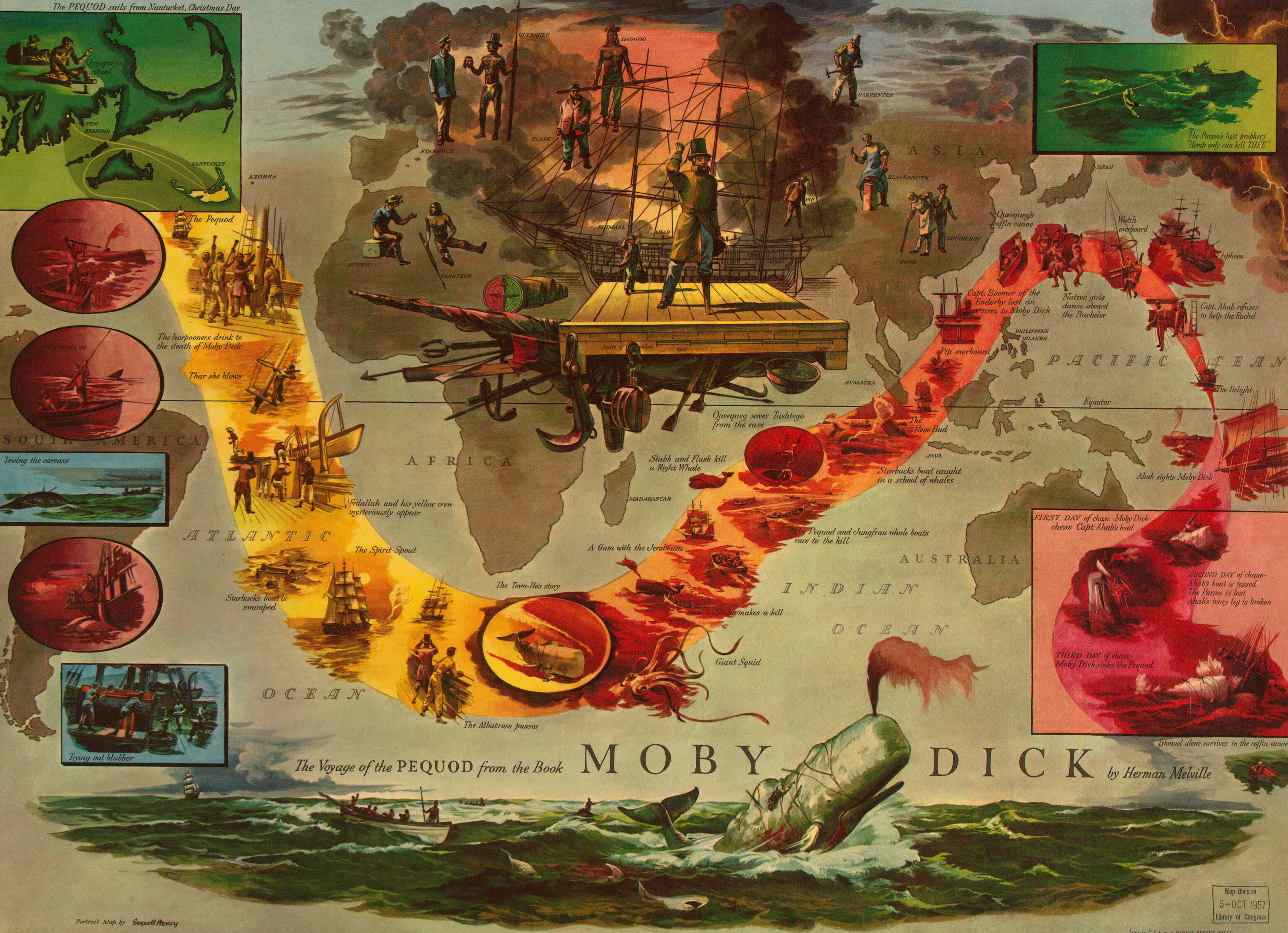
Kayla's Final Essay #1: Moby Dick and Online Communities

A traditional part of the literary canon such as Moby Dick has a lot to teach us about modern digital culture. The way Ishmael, Ahab, and the crew interact in the novel help us to understand the creation of communities in digital culture today, and their teachings affect the way we produce even traditional scholarly research.

When Ahab tells the crew of their true mission and calls out “Death to Moby Dick!” (148), he immediately creates a tight-knit community. The crew looks to him as a leader and holds a common goal of killing Moby Dick, even though Ahab is the only one with a reason for a personal vendetta. We see similar types of online communities forming around specialized topics as well. These communities often create the kind of enthusiasm that gives them the title of “fandoms.” One of my classmates, Victoria, posted a series of blog posts and wrote a paper on the value of fandoms in digital culture, commenting on the need to remove a sense of apathy toward the study of the humanities. The formation of these fandoms may seem to happen over a short period of time, as it does in Moby Dick, but their influence is far reaching, creating interested consumers and content creators who are anything but apathetic.

One of the great contributions of online communities is the way they assist us with research. We are supposed to consult experts in a field of study, but how do we decide who is best? In our current abundance economy, we can find more information than we know how to process. Online communities help to narrow down the most important experts by collaboratively picking them out of the crowd to focus on.


Researchers in the digital age learn to focus on the people instead of simply ideas. Moby Dick focuses on a single whale, but the people involved and obsessed with the whale are much more important than which whale is being singled out. The enthusiasts and experts, who consist of Ahab and others, point us in the right direction. Moby Dick allows us to understand the need and uses for online communities, and more importantly, it helps us to take advantage of them to get to the influential people on certain topics. 

Digital Culture's Subculture: Reflections by Amber


Coming into this class I thought I had a pretty decent understanding of what the internet was. Turns out, it’s more than just a source where people watch youtube videos, look at pictures, blog, and research. It’s an entire culture (digital culture) that’s made up of subcultures where people with specific interests can connect, consume, and create content.

In Lizy’s research and projects on fandoms, I’ve seen how people really dedicated to a show like Agents of S.H.I.E.L.D. or Doctor Who will collaborate with various forms of media (Tumblr, Pinterest, even Google Doodles) to share their passion in memes and other remixed content. I think more specifically I’ve seen the subcultures of digital culture with Greg, Heidi, and Paul’s extensive research and analysis of video games. They have a lot more information on how people inside and outside the video game community are grappling with issues such as gender politics and identity both online and offline. Ultimately, entire communities exist in the digital world. Whether it’s with Pinterest, online games, fandoms, Youtube, these are not just people using the internet to share their content. It’s people using the internet as a member of online mini-civilizations.

When I read Understanding Media: The Extensions of Man, I found that I rather agree with Marshall McLuhan on the idea that the medium is a part of us; it is an extension of who we are as creators and consumers of content. No matter what position on the long tail of interests we pursue, there’s always going to be someone else out there who is using the internet to research and invest their time and energies into something we like too. I honestly really doubted the idea of socialproofing. I didn’t think anyone would be interested in my ideas of authors entering the digital age. Or at least I didn’t think I would hear anything from people who were apart of this subculture. But after investing my time in getting social proof (with Google+ updates, sending tweets or emails, commenting on other blogs, etc) I realized that it actually can work. You just have to ask the right people. Talking with our homies or peers is easy, and finding scholars or activists in the communities you’re interested in becomes easier when you start really reaching for student research and crowdsource information to get your ideas out there. Digital culture, in its subcultures individually and combined, are an extension of ourselves and our ideas with the collaboration of others in the same interests.

In all of this new understanding of subcultures in digital culture, and how we use these subcultures to explore our interests and creativity, there is still a lot that I have to learn and more importantly utilize. I now have a blog account, a google+ account, a twitter account, an lds.org account, and I've never been that active online before because I've never had the desire to be out there that much on the internet. Now I know that it isn't such a bad thing to be active online. It's like being in a second world where I can be out at sea and explore on my own ship, then I can talk with other crew members in my subculture, other ships in other subcultures, and ultimately have my own life online too.

Wikipedia Creative Commons Image
(a clearly very accurate depiction of subcultures on the internet in my journey through digital culture)

Final Digital Culture Blog Post


The concept of social proof has affected my thinking the most about digital culture. Though digital culture is a broad subject, to me the power it has to connect us with others and to exchange information and ideas is the most profound aspect of it. Before this course, I liked social media and used it to communicate with friends, family, or to entertain myself, but I never considered it as way to do academic research. I recently completed a final for my English language empirical methodologies course. Most of the final consisted of the instructor posing research questions and then asking us how we would go about answering the questions. One thing I noticed in many of my responses was a suggestion to search social media sites as one research method. I also suggested communicating with others either face-to-face or online as a valuable research method. I think without the understanding about digital culture that I've gained in this course, I might have restricted my answers to only more traditional academic methods, which can be much more isolated. 

I used a combination of online social proof and face-to-face social proof in my final project. I talked with professors, friends, family, coworkers, and campus departments about my ideas. The main part of my final project was getting feedback/social proof from BYU's international student population via an online survey. It was amazing to get 350 responses to my survey. As I read through what each international student thought, I gained a better understanding of their perspective and felt more of a connection to them.

Though this post is older, I really enjoyed what Paul had to say about digital culture and connection. This ties in well with my thoughts about social media and social proof and how research can and should be done differently in this digital age. He says, "New technologies give us different powers of connection, and thus the powers to alter the meaning of nearly everything in our lives." I too agree that connection gives meaning to life. Even though digital culture technologies are many times used to exchange superficial pop cultural text or images, there is still great meaning in the exchanges because people are connecting with each other like never before. And the digital culture world of connection has the capacity to allow for the exchanging of new research, great ideas, meaningful questions, etc. So my understanding and respect for digital culture has been enhanced through learning about social proof and connection while I strive to practice it myself.

How I (Kayla) Have Come to Understand Digital Culture

As a 21-year-old college student, it's easy to think that I was just born digital (and therefore don't need to make a focused study of digital culture). But while I may be a technology native in some ways, some of the main concepts of our study of digital culture have been new to me, or at least my conscious mind, this semester. I think everything can be tied back to interactivity and Web 2.0.

Now, things on the Internet are a lot less passive. We don't just consume, we also create and connect. My own project on citizen journalism grew out of this concept in a way. Since anyone can create content, I started to wonder how the crowd assigns value. It depends on the way we connect. Does an article shared through a social media platform have more value than one you find through an established news source? Sometimes, it does. You can see this series of blog posts to see the evolution of my thoughts from wondering about how we assign value to considering the pros and cons of assigning high value to citizen journalism to creating my guide to best practices in citizen journalism.

My project wasn't the only one that deals with creating and connecting in digital culture, however. In fact, it's hard to find a project that doesn't do that. In the beginnings of Kelsey's project, she realized how important metadata was and how applying tags really helped in searches. If creators are aware of their connections and users when they make their content, everything ends up being a lot more helpful for everyone. Amber created a blog of Moby Dick that took the static content of Moby Dick (think Web 1.0) and reformed it into something completely different (and with some elements of interactivity at that).

Even topics we highlighted in class all come back to the ideas of Web 2.0. We talked about LDS General Conference and the different ways people connected over the content. The hashtag #ldsconf trended around the world and people collaboratively shared notes in real time. Exploring these new ways of sharing gets people really excited. I remember when I first saw this video on the launch of a homemade spacecraft. My dad showed me and said, "Look, Kayla! You can see the curvature of the earth!" Things that excite people inspire them to create instead of simply consume. They see that even amateurs can make a device that can view the curvature of the earth.

As my fellow classmates and others in the digital world today have noticed, content gets better when more people contribute to it. There really is a wisdom to the crowd. Things that would have been impossibly large before become manageable when crowdsourced.

Web 2.0, besides being the basis for many of the digital culture concepts we covered during the semester, has also led to the improvement of the way the Internet serves us. There is so much we can learn from each other, and online interactivity lets everyone share their expertise (even for free!). Sometimes we criticize new technology and the media, but we shouldn't--if anything, now we are only criticizing ourselves.

Saturday, December 14, 2013

Final Paper

Here's the link to my final paper. The title is pretty long: American English Perceptions Among Brigham Young University International Students and Social Media Influence on Language Learning and Dialect. The length of the title and the length of the paper go together well. I learned a lot about writing survey questions, analyzing data, and APA format.

One interesting result that relates nicely to our digital culture class was that the majority of non-native English-speaking international students reported that social media has helped them improve their English. So once again, social media can be a valuable academic tool :)   

Wednesday, December 11, 2013

Completed Final Project: Guide to Citizen Journalism

I've finished my "Beginner's Guide to Citizen Journalism"! You can see the (more nicely laid out) PDF version here, and you can download the EPUB here.

If anything, I've just learned that I have a lot to learn about the EPUB format. After exporting my InDesign file to EPUB, I tried my hand at cracking open the file and editing the CSS. Basically, you have to save it as a .zip file and then unzip it to access the CSS. I fixed it up a bit, but I'd still like to learn more about formatting EPUBs so they look a little nicer.

Coming next is my submission to the outside world.